Visit to China
The flight to Beijing was delayed due to the late arrival of the incoming flight from Shanghai so we left late, sometime after eight o’clock at night. It was dark quite soon into the flight but when we woke we were flying over a pale brown waste land of hills which according to the flight map was Mongolia and what looked to be like mud huts and walled enclosures sprawled across the valley was the city of Ulan Bator. From the air the land looked so barren it made you wonder why anyone should want to fight for it.
When we arrived the short plump Chinese girl holding up a card with our names on it announced herself very improbably as Joyce, but most Chinese adopt and English name which to them has certain similarities with their own, or they mjight just chose one they fancy …and took us across to our car and introduced us to our innocuous looking driver. After a leisurely drive into Beijing he wended his way through some dubious looking back streets and turned into our hotel. The Bamboo Garden Hotel is on the site of an old garden and was a haven of peace in the bustling city. It was not a five star internationalhotel but its other attiributes made up for its lack of modernity. With its yellow silk cushions and the red silk drapes on the four poster our ‘suite’ looked more like a set for a better class brothel. Birds roosted in the trees and the bamboos but any traces of their droppings were carefully washed from the paths in the morning which is more than could be said for the expectorations on the pavements in the town outside the walled garden
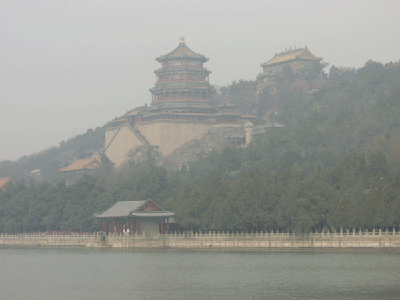
The first morning we were picked up by our guide and chauffeur punctually at nine and taken to the summer palace. It was a national holiday and most of the rest of the 18 million inhabitants of Beijing were also setting off very good humouredly for a day in the ‘country.’ Despite their anxiety to get us to the summer palace before the crowds we nevertheless had time for a factory outlet shop selling pearls. We were shown how the small sections of ‘muscle’ were cut up pasted in the oyster, which then builds a pearly film over it to stop the irritation of the foreign body… Of course they were very anxious to sell us something and of course I bought something but not as much as they would have like to sell me. .
Next stop was the summer palace which is when we began to realise that our driver was something special. I think he must have been used to driving a high party official because he just assumed everyone would give way to him. There were some quite hairy moments when people were reluctant to give way to him, especially when he did u turns in main roads or reversed back to a missed turn off, but fortunately mostly they did give way.. The Summer Palace is situated on a large lake on the northern outskirts of the city. This is where the royal family went to avoid the heat of the city in summer, hence the name. The dreadful custom of breaking a lady’s feet and binding them so that they were only about three inches long meant that a lady could only hobble painfully for short distances so the Empress could not enjoy the lake side walks and ornamental gardens without frequent stops and she was mostly either carried in a sedan chair by eunuchs or taken for a ride on a boat. Lots of families had brought picnics and were eating them on the banks of the lake or on pedalos out on the water which kept getting in the way of the ferry boats taking people across the lake. It was all still quite good natured when we left but some tempers were beginning to get a bit frayed.
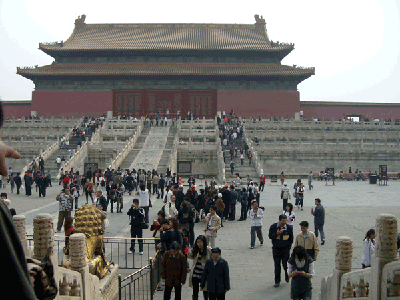
We went back into the city to see the main residences of the royal family which are in the Forbidden City. Until quite recently no one was allowed into the vast enclosures of palaces and temples which were in effect home to the emperors but a prison for the empresses and his concubines who were not allowed out of the city, except for the annual expedition to the summer palace, which then became a new but much pleasanter prison.
The emperors all seemed to have been very superstitious. The site for the Forbidden City was chosen very carefuily and it was situated on a so called meridian line to ensure that it was the most propitious place for the emperor to live and the art of feng shui was used to decide on the position of the buildings and the placing of the doors and furniture. We were told that one of the emperors used to be awoken at 4 a.m. so that he could get to his office and work before the others got up, but then we were also told that some emperors never did any work, plied as they were with food and liquor and an endless supply of concubines, who could be obtained and disposed of at will.
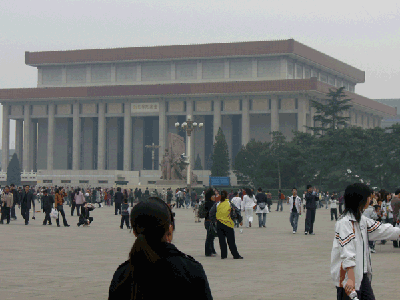
Across the road from the Forbidden Palace and still on the north south meridian line is Tiananman Square, supposedly the largest open public space in the world.
A portrait of chairman Mao smiles indulgently down at you from the law courts and the national flag is raised and lowered ceremoniously every day. It being a public holiday the square was filled with visitors from all over China, some who were obviously making a day of it with picnics and kites.
And last but not least still on the meridian line chosen to prolong the emperors life was the Heavenly Temple so it was not far for the emperor to go to ask for the gods blessings but although it was not far he only went two times a year. Before his visit he was supposed to fast and not indulge in women or alcohol for a month but they gradually reduced the amount of time from a month … to a week …to two days … to a day and eventually .. to a couple of hours.
Considering that China has been a communist country and during the Cultural revolution they systematically destroyed most of the cultural relicts of the country we were surprised by the obvious interest of the throngs of visitors following their guides round the palaces and temples fascinated by their erstwhile rulers.
That evening to finish off we were taken to the Beijing opera. This is not like a western opera. There was some singing but the spectacle was more important, the colourful costumes and make-up and the dance and acrobatics of the characters was more important than the musical content, which since the opera we saw was the Monkey King, could be more classed as ‘caterwauling.’
The next day we had to be ready to leave at seven to go to the Ming tombs and the Great Wall. The emperors seemed to have spent most of the time when not engaged in eating, drinking and concubines in obsessing about ways to make themselves live longer and to enjoy life after death.
It took the emperor 2 years to find the right site for his tomb and when he had found it he had a miniature forbidden city built underground to accommodate himself and his wives; the wives of the earlier emperors were killed or entombed with them but some of the later ones very kindly let their wives live out their own lifespans,
We still had time to visit a cloissone factory and a jade factory where we watched jade being carved and polished. Very sensibly these factory outlets provide good eating facility so the tour guides take their clients there for lunch, and shopping.
Cloissone is enamel ware. The girls working on their holiday were glueing wire to brass ornaments, plates, jugs and bowls and then coloured enamel powder was inserted between the wires before they were baked and polished. Because of the name and its association with Faberge eggs and other ornaments I thought it was a French process but we were told it originated in the Beijing area of China.
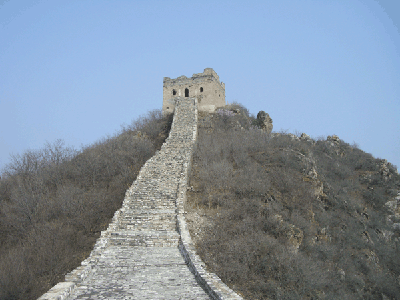
I had always imagined that the Great Wall of China was one long wall but in fact it is bits of wall, built in the places where it was easiest for the Mongols to get through to steal, burn and rape. The bit we were taken to was some 70km from Beijing, supposedly because it is the most authentic bit, but I expect that is what they tell everybody as the couple at the next table at lunch were also going to the most authentic bit, but it wasn’t the same bit! .
We went up a rather elderly and ramshackle chair lift. The ‘eggs’ accommodated two people and were open so our guide had to go in a lift of her own. When we got to the top she was shaking and we discovered she was terrified of heights – today was going to be a torment for her…. After the ‘chair lift’ there was short funicular railway – in which you sat looking back down the mountain and after that there was a walk across the hillside to the access point for the wall. When she got there she collapsed and refused to go any further – it was the furthest she had ever been on the wall – though she had been on it at some easier access points.
On the way up we were accosted by local farmers who were squatting on the hillside like a group of baboons. We said ‘ni hao’ [hello] to them and then two of them attached themselves to us and wouldn’t go away. They were both very nice ladies with very mongol features. They had farms on the ‘other’ side of the wall but did this to earn money when there was no work to do on the farm, or possibly when they thought there were suckers about, and it was a national holiday so there were quite a few. Naively not realising they wanted to sell things we chatted to them and they were quite helpful, holding my arm on the difficult bits so when we were going back down I offered them some money as a tip but they wouldn’t take it, tipping is discouraged, but they very much wanted to sell us some books, or anything else, tea shirts , table cloths, all sorts of things in their bags. In the end we settled for one book and gave the other a tip… we had thought they were mother and daughter and would split it but they weren’t and the rivalry began to get heated so we made good our escape whilst they were arguing.
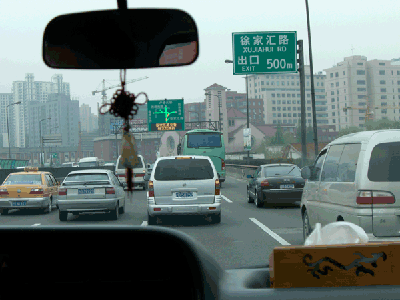
The drive back to Beijing was quite fast as our driver wove in and out of the traffic overtaking, double overtaking, undertaking and driving on the hard shoulder. That evening we ate in the hotel and chatted to a couple from Aberdeen.
The next morning we were to be picked up at 12 to be taken to the airport so after breakfast I had a foot massage from the hotel medicine man. It was very good quite hard but good. He said I was having bad dreams – which I was although I don’t usually, and he also said I had stomach troubles, which I do.
If we had been staying longer he said he could have done something to help me but it was time to go to the airport. ‘Joyce’ gave us a decorated paper she had cut herself and nearly cried when we left. She watched us go through departures until she could see us no longer. The next stage of the trip was the four day cruise along the now flooded Yangtse Gorge.
The plane was late, of course, and I got a window seat as there were not many people on the flight – however there was thick low cloud all the way and we saw absolutely nothing. Visibility at Beijing airport had been 500 metres max, at Yichang it was perhaps 750m. We were met by a young man and a woman driver … , he took us to the obligatory factory outlet on the way to the boat, in this case it was a silk factory and they showed us how they took the cocoon from a silk worm and pulled it out to the size of a double bed quilt. Then we made our way to the quay but there had been an accident and there was an impossible traffic jam so we went back and took another narrower road over the hill through the old areas with people watching telly and eating in the streets, lots of very squalid shacks.. and very thin stray dogs and we met a lorry coming up the hill towards us round a bend on the single track road – he backed down a little to allow us to squeeze past and a car overtook him jamming everything up completely. Chinese drivers make French drivers look good – they over and under and double overtake.. a child nearly ran under the car and we nearly had hundreds of scrapes but we seemed to avoid them all somehow – the young lady driver shouted at the man in the car and he shouted back and refused to budge, so she took her keys out of the ignition and obviously said something very rude and eventually he backed down a bit.. and we got to the quay … we were given a fanfare as we got on to the boat – there were only 54 on the boat which takes 190 so it was nice and empty from our point of view…
We had dinner on our own in the restaurant.. that night there was an almighty thunderstorm with almost constant flashes for nearly two hours and the thunder was crashing all around us … but it did have the effect of washing away some of the heat haze and later the sun came out and it was quite hot, people were sunbathing on deck. We ate at a table with three Australians, two sisters and the young Russian video maker. who spent his time taking cruises on the boat and making a video of the cruise to sell to the passengers. .
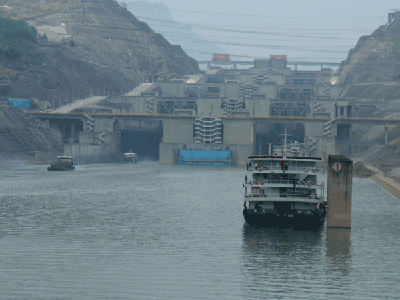
We set off the next morning and sailed a short way.Then we got off and had a bus trip to the dam which is immense. We thought we were going to get to see the turbines but we only saw the outside and the locks… The guides are very cagey about getting into arguments about the pros and cons of the dam .. it is about 450 miles long and 176m high at the dam. A large amount of land has been flooded and 1.2 million people moved. Most of the people moved were elderly farmers and the younger ones are supposedly quite happy with the change but the older ones who have been dispossessed do not know any other way of life .. all the land belongs to the state so they don’t own it….and the state can do what it likes with it.. so it can just ‘take it back’ and chuck any one off at whim and when their intial tiny compenstaion runs out they have to go round on their very elderly bicycles collecting cardboard and other waste materials to take to sell.
The dam has 26 turbines but the Swedish lady on the boats said that she understood that they don’t all work… The lift system for smaller boats does not work either and will have to be replaced with a gear system, which we imagined must be a bit like the Falkirk wheel.
All the people who have been displaced as the river has been flooded have been moved into new ‘towns’ where they are supposed to have been given larger flats and have access to electrical equipment that was denied them before in their subsistence way of life. This means that they all now use more power so that the power generated by the dam is used locally and not sent to Shanghai which was the original intention – a bit of a new take on the vicious circle…
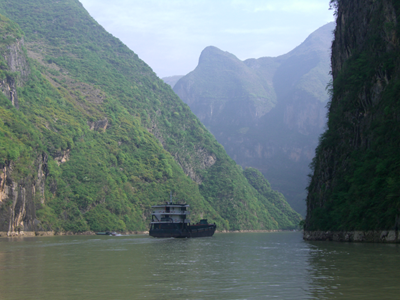
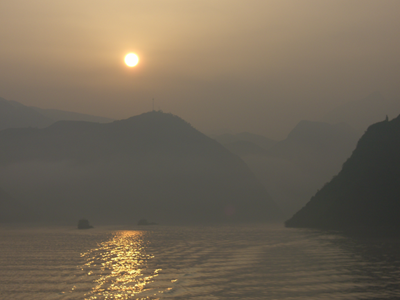
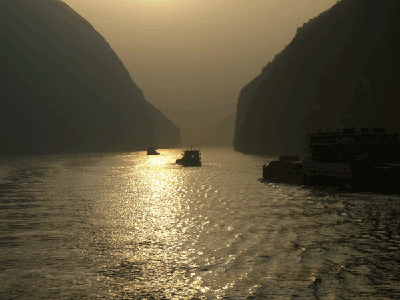
After the visit to the dam we sailed into the Xiulin Gorge. It is very long and very impressive. It was hard to imagine what it must have been like before it was filled with water… it is very beautiful full of water and it is much easier for navigation but …. We were also told that it would save lots of lives because it would control flooding, which occurred every ten years or so but .if the dam were to burst it would kill millions of people downstream literally millions …. They said about 13 million but that is probaby an underestimate..
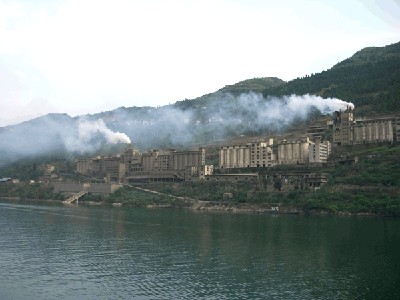
The people whose houses were higher up the hillside were not dispossessed but the infrastructure has been fractured – houses without apparent access roads because they roads are now below the waters.. there were some new roads being made and the rocks were crashing down into the water like calving glaciers… there were also cement factories and coal mines… the coal was in heaps on the hillside waiting for the boats to come along and be filled by chutes.. we saw one whose coal overshot the boat and splashed into the water the other side of it. That afternoon we had a talk from the doctor on board about Chinese medicine but as he spoke little English we had to keep waiting for the translation…
One evening we had a fashion show, traditional historic to modern day costume very well presented and almost professional. We are finding the obsession with their past very interesting – they lost so much with the cultural revolution when everything was destroyed so now any pictures of the places in the past have been garnered from anywhere and ‘restored’ – old post cards made into pictures to hang on the walls In hotels and boats… and a fascination in visiting any old places which escaped being destroyed…Joyce’s famiy had a cloisonné bowl which her family had buried during the Cultural Revolution and dug up again afterwards – as so many did but much more was lost, which they now regret.
Next day was a wonderful trip through the next gorge… and then we went on a smaller boat to go through more gorges on a tributary. There was a lot of sediment being washed into the big river ,, there are lots of signs on the hillsides which they were not in any hurry to point out to us – though one person said they said ‘Down with the government’ – as an anti flooding protest – the strange thing is that they are left up – perhaps that is the latest policy – leave and ignore or perhas they were just in the most unaccesible places so no one could get to them to pull them down. Their appetite for bridge building and massive infra structures projects is unbounded – most of the old bridges have had to be raised – towns swept away and new roads built everywhere – to join up the people who now live on the hilltops but whose roads are now underwater. The land higher up the mountain slopes is less fertile so there are fewer farmers and more people have been moved into the huge blocks of flats in the city – reminiscent of our industrial revolution and the clearances but on a much greater scale - millions moved at a time.
There was a painting demonstration on the boat one day and kite flying, silk embroidery and snuff bottles… they try everything to keep us amused. ‘Michael’ the general compere has something of the commuist cadre about him very nice, very well informed tells jokes, but somehow in a humourless,. learned way..He is very nice – but one suspects at heart he is a cadre.. quite pro government. Government is mentioned a lot in talking about the new developments and he talks very proudly of his new flat and his home town Chongquin. They have all got larger flats – but they still have to pay rent for them. So how the older people manage tends to be glossed over, and we have seen some pretty squalid accommodation on the outskirts – as everywhere else in the world.
This morning we woke to a terrific thunderstorm. We are at Fengdu. We are moored in a very wide stretch of water with a huge town on the opposite bank and some tourist attraction – the ghost town on this side.
I was feeling a bit tired and one of our table mates had been told that this was the excursion to skip so I decided to stay on board and catch up on a bit of sleep as we had not been sleeping very well with the heat in the cabin and the thunderstorms so we had a very restful day. The next day was not restful as we disembarked at 8.20. Our driver took us to a rather tatty looking Hindu temple in the town . of Chongquin – which used to be the capital city when the Japanese had taken overt the East coast. It is a very large city about 6 million we were told but that is probably just the centre as the official figure is nearer 31 million and growing steadlly and it is the largest city in the world although very few people have even heard of it. . The part we saw seemed quite nice, set on a hill. We found the enormous population quite difficult to cope with. There were just so many people, cars, bicycles, people wandering across the roads, cars turning in and out, everyone is in a hurry and they just push past.
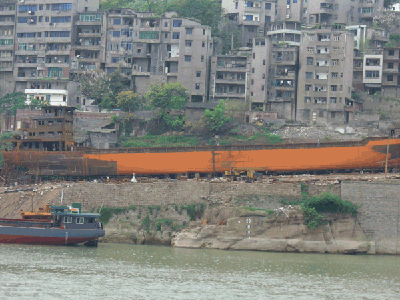
We were also taken up to a park on a hill top, Goose Neck park where we were shown a map of the whole proposed gorge system, but it is very hard to imagine how much more land is still going to be flooded. They have been building new bridges all the way up the river as the old ones are not high enough for the shipping to go under when the water level is raised. There are also lots of ships being built just beside the water’s edge with people working on them all the time. In these upper reachers the water has not risen much yet as the valley bottom is higher than down the valley but it will make an enormous difference when it does rise. The young people say they are quite happy to be moved into the towns and given bigger flats, but one guide said her granny had cried for days at being moved from her little farm. There is quite a lot of employment for the young and fit in the reconstruction but there must be a lot of people who can’t adjust to ife in the cities and city jobs. There are a lot of old people riding round on bicycles going through the waste paper bins and carrying plastic bags of rubbish.
We flew from Chongquin to Xian our next stop to see the warriors. That night we were taken to the Tang Dynasty show, which was a dinner and a musical performance, which was excellent. The colourful costumes and the music and dance were superb, marred only by a neighbouring table of Chinese, one of whom constantly used his cell phone and then woke his neighbour up to tell him about the conversation he had just had. Our neighbour at the table also had to ask two Canadian men at the next table to stop talking. At the end one of the Canadians had a go at him and they nearly came to blows… but not quite….
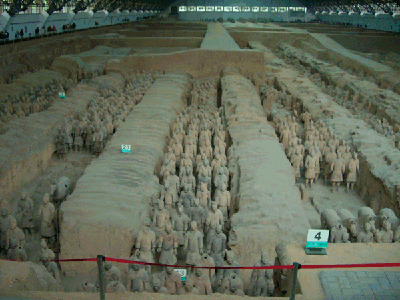
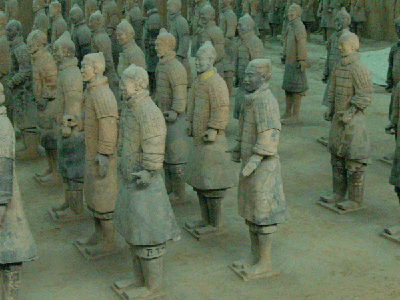
The next day we went to see the warriors but before that we went to the Buddhist temple nearby in Big Goose…which is like the other temples but a bit less tawdry. The warriors are some 50 minutes out of town. They were first discovered in 1974- just before the end of the cultural revolution, which was really cultural destruction. Three men were sent to dig a well and when they got down to about 5 metres they started bringing up bits of pottery. Fortunately some of their superiors realised the significance of the find and rather than destroying it it was noted and later excavated. The Emperors of the great Chinese dynasties like the Egyptian pharaohs were so spoiled in their life they could not believe they were going to die and so they wanted to make sure they had all their goods and toys with them for their after life. In this case the emperor had a whole army complete with horses and chariots built to look after him. It took forty years to build by which time he was already dead and no one has yet found where he was actually buried. Eventually the people got fed up with doing all the work, especially as it is rumoured that the emperor held a big party for the workers in the tomb and then had them shut in it so that they died there. Later people broke into the tomb and smashed many of the terracotta soldiers and set fire to the wooden roof supports so that they fell in on top of the model army. It lay undiscovered for centuries.
On the way back we stopped at a site on a hillside with a hot spring. The emperor and his concubine used to go there for the summer to get away from the heat of the city. It rained all morning when we were visiting the warriors but when we came out the rain had stopped and for the first time we could actually see the countryside and the hills, but not for long, it was soon misty again. One of the things I will remember most is the constant pale yellow smog-like mist which I found very claustrophobic – but then most people would find our constant rain hard to live with… as we do!
Next day we went straight to the airport and caught a plane to Guilin. The man next to us had eaten enough garlic to stink the whole plane out so it was not a very pleasant flight. Conditions are a bit rudimentary on East China Airline. On one flight we were just given a bottle of water each. Lunch on this one was a ‘bread bun’ and some pickles, a cup of water and a very small packet of dried apple. We were met by a cheery young guide who called himself Frank. We had a visit to fit in on the way to the hotel about which we weren’t vey excited as it was the Reed flute cave but it turned out to be quite spectacular as caves go, well lit and easy to walk round. Then we had to visit Fubo hill which was really not exciting but then he took us to dinner in a local ethnic restaurant… which was educational. We persuaded him to sit with us, though guides are not usually allowed to but in this case we needed him to tell us about the food.. the chicken is mostly lower leg and feet and cut across so every piece has bone in it… and not much chicken. The vegetables are usually Pak choi and the spicy meat was hot. We have noticed that there doesn’t tend to be much meat in the meat dishes. But we had a very interesting conversation. He comes from an ethnic group. He could not afford to go to university so he studied at evening class. His parents have a farm and his mother always tolld him to eat every grain of rice on his plate because a grain of rice represented a tear of sweat from the farmer’s brow. He held his rice bowl just below his mouth and shovelled the rice in with his chopsticks in a way that Garfield would have been proud of. There was too much for us so he took the rest of our meal home for his supper.
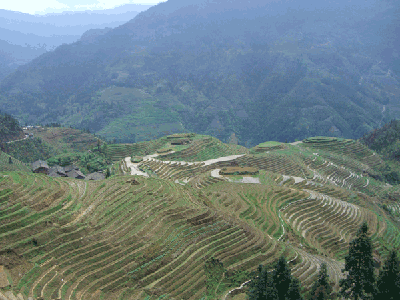
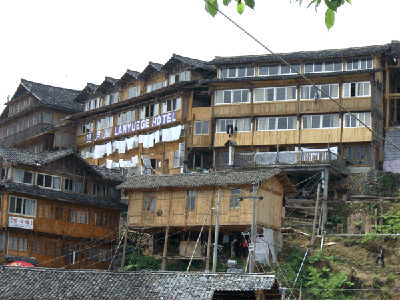
The next day we went to the hill rice paddy fields at Long ji. It was along ride in the car first but that was interesting as we saw paddy fields with buffalo working in them. Then we went over a pass and the lady driver seemed to think that it was a challenge to see how far she could get up hill before having to change down gear. There were also times when she did not seem sure which side of the road she should be driving on especialy when going round hairpin bends, which made life quite ‘interesting’ but on the other side of the pass the sun was nearly shining. On the other side we turned into a valley, which we went along and then the road twisted up the hillside, and she drove as fast as you could with the car screaming its guts out and then we for the last bit we had to get out and walk. Of course we were accosted by people selling local and not local things but they were all very pleasant. The scenery was amazing, the buildings were all wooden, like a Savoyard town with the roofs all higgledy piggledy and walkways between the houses. There is lots of building going on as it is a tourist place 90% of tourists are Chinese. A lot of them have come back to see their own ethnic area and were having their photos taken with girls in traditional dress. In places it felt very like, northern Italy, the Alto Adige, and parts of Switzerland. We enjoyed it very much. On the way back we visited an art gallery where they showed us how to paint with a single brush and black ink – the usual bamboo… the young artist was in a suit and tie… the paintings were not the sort of thing you would buy as a tourist… we went to the hotel and then walked in to town. The one big department store was very expensive and the other was like a poorer English market. They were setting up the stalls for the evening market – they just flooded in on bicycles with trailers. Their stalls wer folded in the trailers, they whipped them out, unfolded them on their own numbered pitches amid a lot of cheerrful banter and started selling.
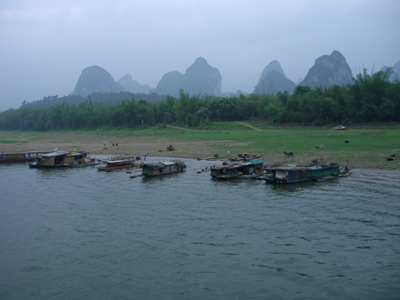
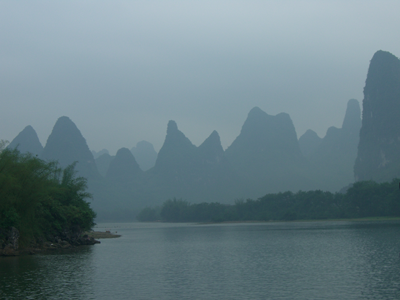
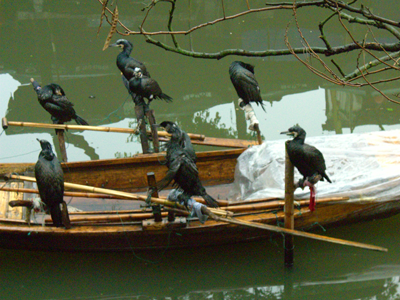
Next day we went on the river Li which is the picturesque river which goes through the mountains and is geatured on some packets fo Earl Grey tea. Boarding the boat was something like the pictures of people boarding the Nile river ferries but on a smaller scale – lots of boats all moored up together but a bit more shanty townish. “Foreigners” and the more important people were upstairs away from the general riff raff who seemed to be having a ball downstairs. During the ‘voyage’ we all went on the deck which was in fact the roof of the boat. The river is quite shallow about 2-3 metres so the boats are wide and top heavy. There are some minor rapids on the river which the boats siddled down like elderly matrons. They go down the river with passengers and then charge back up again against the current without any passengers and with the washing blowing in the breeze hung out on any thing possible and the cooks finishing off the washing up on the back of the boat. Boats going up river have priority and they decide which side they are going to pass on and hold out a red or green flag – usually it seems to tbe the captain’s wife standing there with the flag. It would be so much easier to have a coloured light – it would be easier to see as the flags can be hard to see – some short staffed boats just had them stuck out of the window and as they were blowing it looked just like a stick. There were farms, paddy fields and pleasant villages on the banks . it is a tourist area so there are walking and biking trails [ the bikes looked a bit heavy and industrial!] and there were little boats made out of bamboo logs with a basic outboard motor and someone standing at the back to steer them. They were made out of five or six long bamboo trunks and sometimes parts of them were under the water. Some had seats on them and were taking visitors for rides others came alongside to sell us things and some were just going to town and back. Fuel is expensive for them. There is a marked difference in the way of life in the town and courtyside, as there is everythwere. Rural life is much simpler. Our guide was called Frank and came from a farm in the hills. His parents have never had a holiday other than an occasional day out in Guillin. They have three sons, son 1 works on the farm which they lease from the government for thirty years, he is son 2 and he worked and learned English and tourist at evening class and son three works in a factory making tooth brushes. He says there is a lot of unemployment in rural areas. They were born before the restriction on family size. The nice lady driver has a daughter and a son. She could have two children because they have a farm and they can go on having children until they have a son, but now they have to wait six years between them.
The atmosphere on board was quite pleasant and friendly. On the whole we found groups of Chinese very loud and cheerful. What sounds like a big row seems to end in laughter or smiles, usually… . some just seem to talk very loudly. As we were travelling on our own we were put to sit opposite some very nice better class Chinese mother who looked school teacherish, father who looked businessman and daughter – but they could not speak English beyond numbers to 5. So apart from a lot of smiling communicatio was a bit limited and at that time my Mandarin didn’t go much beyond asking where the toilets are and understanding the answer.
The area we passed through was larger than we expected – the hills are just like in the pictures, not surprisingly but they are quite a lot of these strange hills. They did look more mysterious in the mist and when the weather did brighten up for a bit they looked more ordinary. It was nice to see water buffalo grazing atht water’s edge. Frank says they have a water buffalo and a calf. The buffalo is worth 5000 yuan and takes a long time to train. Now they have finished doing the poughing and the seed has been planted so the buffalo are out to grass- one person will mind all the cattle from the village – he used to do it when he was young.
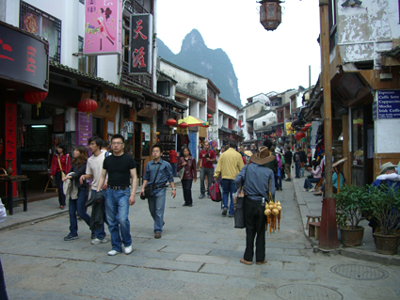
We got off the boat at Yangshuo which seemed to be a nice little town which catered for the local tourists. We would have liked to stay a night there but we didn’t have time on our schedule –there is a good water show there at night. There are also some nicer tourist souvenir shops and if you say ‘bu yao’ [ not want] loud and clearly enough the vendors leave you alone to browsethe shops. Our valiant lady driver got us back to Guilin so early they did not know what to do with us so they took us to a Chinese massage parlour where we queued up with the locals for a pumelling. They massage you over your clothes, buttons, zips and all, which I found a bit uncomfortable strange but I definitley did feel better when it stopped! As my husband said ‘if they did that on you without your clothes on you would be black and blue’ so it is just as well it is through your clothes….
Our last stop was Shanghai, the flight was delayed and when it did leave it was very full, a bumpy flight and the plane food is not to be recommended. It consisted of little foil packets of horror and a very artificial bread bun.
but that is another story.
Back to top |