Links |
 |
Extreme mountain sports and expeditions - with International High Mountain Guide son Neil |
 |
Creating Smiles – stories, clothes and accessories for girls who love ponies - with daughter Hazel |
 |
Alpine Excellence – Chamonix valley catered or non catered accommodation and how to get the best out of your summer or winter alpine holiday: with daughter Shelagh |
 |
Visit Crinan and stay in our beautiful accommodation. |
| |
| |
| |
| |
| |
| |
Voyage of the Aranui 3 The Aranui 3 is a Polynesian boat based in Tahiti which carries supplies and passengers to the Marquesas islands. |
|||
Day one and the anglophone passengers were assembled in the lounge for the first of our daily briefings: Tall, beautiful Vai in her bright Polynesian dress and her long black tresses wound up behind her head and kept in place with what? a ball point pen? flashed a beaming smile around the assembled passengers like a primary teacher greeting a new class and determined to start well. “ EE YOR AN A !” she said, and added: “Hello!” only to be greeted with the usual half hearted anglo-saxon mumbled response. “ EE YOR AN A, is the Polynesian for ‘hello’,” she said again, in case there were some in the class who were missing the point. Whenever she used a Polynesian word she spoke very clearly, carefully stressing each syllable and usually rolling her huge brown eyes as if inviting you to some intimacy with her. |
|
||
“You are looking for ..white sandy beaches, …palm trees,… swimming in warm blue seas, ….perhaps snorkelling …” she lead us on, drawing us into the typical picture of an idyllic South Pacific Island …. and just when we were all lulled … “Wrong trip!” she said suddenly jerking us out of our complacency, rolling her enormous brown eyes again and hugely enjoying the joke …. a cruise guide with a sense of humour, this was going to be fun! But just before we all wondered what we were doing there, she continued, “Tomorrow we go to FAK A RA VA,” again carefully caressing each syllable, “we have white sandy beaches, palm trees, warm blue sea … and snorkelling… FAK AR A VA ” and rolling her eyes again: “It is Sunday, perhaps you would rather go to the church?” …. |
 |
||
Vai then went on to outline the programme for the day which included arriving early at an idyllic Polynesian atoll, a huge ring of white coral beaches enclosing a blue lagoon with shelving blue water and a vast coral garden teeming with colourful fish, and for those who wanted something more cultural the visit to a service at the small church was a real option. We chose to combine both by snorkelling on the beach within earshot of the joyous singing coming from the open doors of the tiny church, so we hung our clothes on a handy coconut palm, slapped on the sun cream and slipped into the water. The Aranui 1 was a cargo ship which supplied the outlying Pacific islands from Tahiti. The Aranui 2 also took some passengers as well as the freight, and this was such a success that the far-sighted owner replaced it with the Aranui 3 which can carry up to about 180 passengers as well as the freight. Our stay on FAK A RA VA was not very long, but we soon discovered that not very long was all that was needed if we did not want to end up queueing outside the doctor’s surgery for treatment for burns; and quite soon a cool shower and the air conditioning of the boat seemed very attractive so it was back to the whale boats and back on board for lunch. |
|||
 |
Those of us interested in navigation were allowed on the bridge and the captain and crew were very ready to talk to anyone when they were not busy. It was all very informal but the crew were all Polynesian so although English and German speakers were well provided for by the ‘cruise’ staff the ability to speak French ( or even Polynesian) did help when talking to some of the other members of the crew. |
||
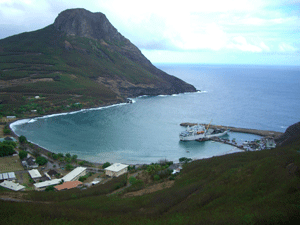
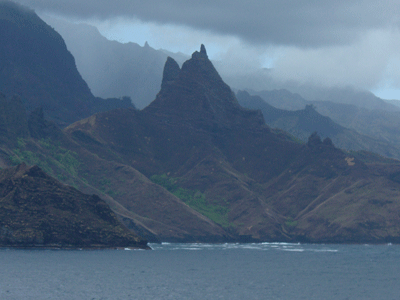
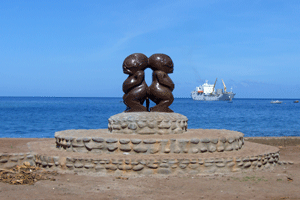
The Marquesas are strangely shaped volcanic mountains rising straight from the ocean bed; mostly covered in impenetrable dense green vegetation, the summits often shrouded in cloud making them look even more mysterious. From a distance they have not changed from the time when the early navigators and Captain Cook first set eyes on them. The population declined as a result of the early visits from the ‘civilized world’ which brought venereal disease, T.B, flu etc. and the missionaires persuaded them to wear clothes and give up all their old cultural activites, which sometimes included eating people they did not like. The islands are supplied by the Aranui 3 (usually every three weeks) and one other freighter, which visits more frequently but does not take passengers. These two ships are the islands’ lifeline to the outside world. On this visit we delivered building materials; 16 cars (mostly 4x4s) ; drums of diesel for the afore-mentioned vehicles, kerosene for a helicopter, sundry tractors, cement mixers, diggers and other machines; much awaited household goods: washing machines, fridges, televisions, satellite dishes and food: chilled meat, carbonated drinks, fast food, ice cream and other sundries, nappies, shampoo, postcards, stamps …. all the trappings of modern life to islands where the ability to live off the land: coconuts, bread fruit, avocadoes, mangoes, pineapples, grapefruit … and surrounded by a sea full of highly edible fish, is rapidly being replaced by Pringles and coke. |
|||
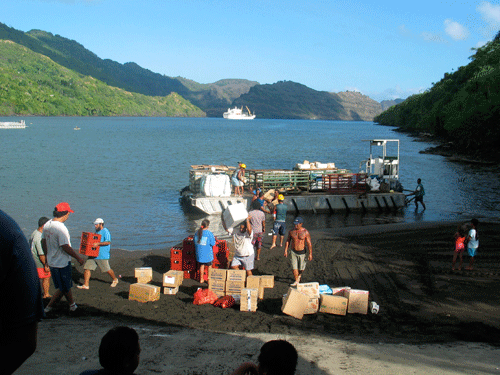 |
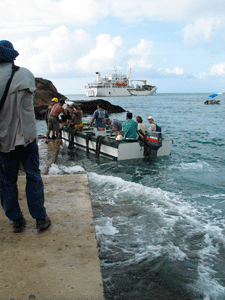
The Aranui visits 6 of the islands in turn, leaving refigerated containers at some of the larger islands and then going back to collect the empties later. Sometimes the Aranui would be anchored off shore and then we and the freight had to be taken ashore by boat which was not always as easy as it might sound especially if there was a heavy swell, (and on our trip there often was), the passengers were ‘helped’ on and off the boats by a team of very hefty tattoed Polynesian sailors who would not have looked out of place in an All Black rugby scrum. If the swell was really bad they quite often picked a passenger up like a sack of potaotes and deposited him ( but usually her) on to the whale boat or on the shore. The men received this treatment less frequentlly, possibly not to offend their dignity, |
||
When we were onshore we were usually given a welcome by the locals as the arrival of the Aranui was always a special occasion. There were always local crafts on display but you were never pressured to buy anything- it was there for you to look at and if you liked it you could buy it. After the greeting, usually a traditional song and dance, we could chose different options which included walks, guided visits to places of interest, and occasionally swimming, snorkelling or diving depending on the strength of the current. On several occasions we had lunch on an island, sampling local dishes at the local restaurant, usually run by the, always charming, lady mayor of the island; or picnics brought over from the boat. Some of the local tours included walks or transport across the islands in 4x4s, (as we had replenished the diesel supplies), and we would meet the boat at a different anchorage. In the evenings informal and spontaeous music, dancing and singing took place on the boat in the bar area lead by the naturally talented musicians in the crew. As with all the ‘entertainments’ you felt that you were being let into their lives rather than that you were being performed for. Some passengers bravely attended a ‘dance’ class and their performances in ‘local’ dress, formed part of the programme of the Polynesian entertainment on the penultimate evening. The men had to be specially congratulated on their attempts to do the ‘Haka’ war dance wearing skirts made of leaves! This is similar to the dance performed by the Maoris prior to a rugby match and intended to intimidate the opposition. |
|||
We grew very attached to our floating home, and for a brief time we really felt we ‘belonged’ to the Marquesas. The people were so pleased to see us and we learned a lot about their way of life and culture. We were very sad to leave them. On the way back we again stopped at a coral atholl RANG I ROA, where the dolphins met the boat on cue and swam and surfed in the bow wave as we entered and left the lagoon, and after a final swim and snorkel and picnic under the palm trees on a coral beach it was back on board and full steam ahead for Tahiti and home. You are looking for a luxury cruise ship, with a large swimming pool, lots of deck games, formal dress and lots of rich food?... Wrong trip! The Aranui is not for you.
|
 |
||
You are looking for a journey back in time to magic lands and places that you can usually only dream about and you want to be part of the journey… the Aranui is for you. Or perhaps. like me, you sometimes like both…. |
|||